
Disclosure: WorkWise is reader-supported. When you buy through links on our site, we may earn an affiliate commission at no extra cost to you. Learn more.
A clean desk doesn't just look better — it measurably reduces stress and visual fatigue, which means you focus longer and make fewer mistakes. The problem with most "desk organization" advice is that it works for about three days. Here's how to build a system that survives six months.
The three rules that make any system work
- Every item has a fixed home. If you have to think about where the stapler "goes," it'll never go anywhere.
- Only what you use weekly stays on the desk. Daily-use items live on the surface. Weekly items live in a top drawer. Monthly items go in a closet or shelf.
- 60-second end-of-day tidy. The most important habit. Without it, you spend Monday morning untangling Friday afternoon.
Layer 1: Define the surface with a desk pad
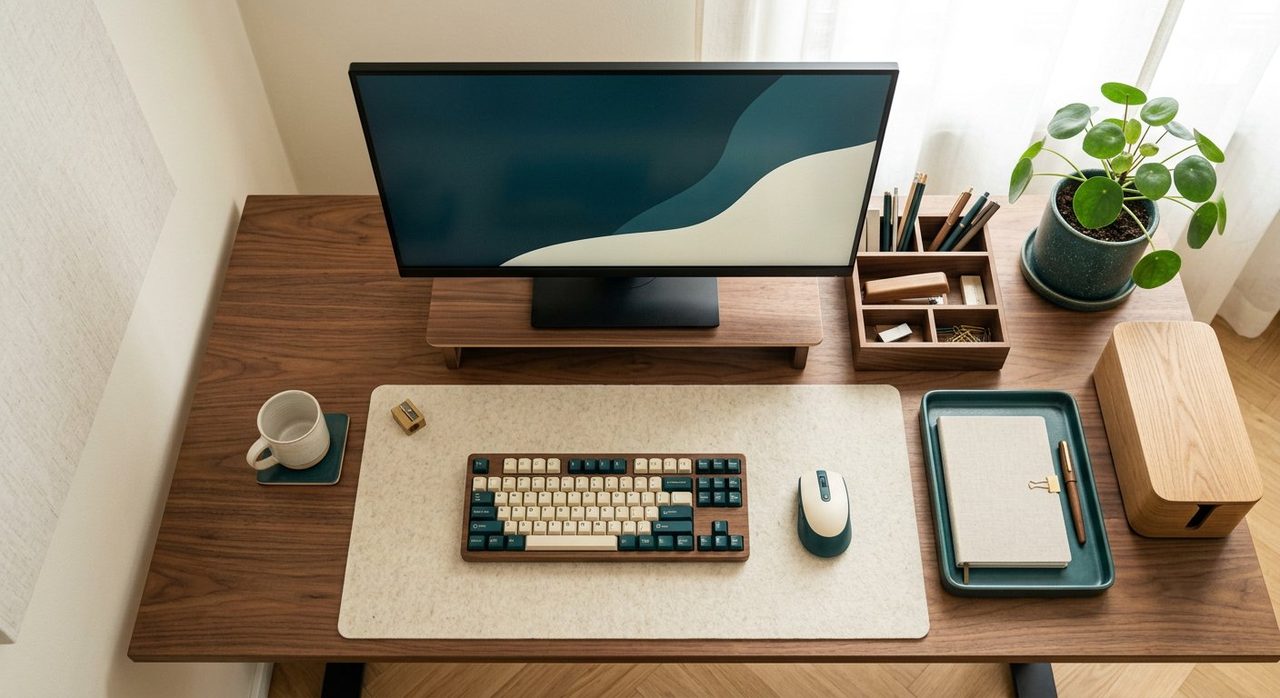
A large desk pad (the kind that covers most of your desk) does more than protect the wood. It visually defines the "workspace zone" — and any clutter outside that zone feels obviously out of place.
Aothia Cork & Leather Desk Pad
Large enough to fit a keyboard, mouse, and your forearms. Water-resistant top, soft underside that grips the desk. Looks like a piece of furniture, not an office accessory.
Check price on AmazonLayer 2: Drawer organizers
If you have any drawers, dividers turn them from junk bins into actual storage. Pens in one slot, batteries in another, charging cables in a third. You'll be amazed how much faster you find things.
SimpleHouseware Drawer Organizers (set of 6)
Cheap, modular, fit any drawer size. Bamboo if you want them prettier.
Check price on AmazonLayer 3: Cable management
The single biggest source of visual clutter on most home-office desks. Three cheap items fix it forever:
- Under-desk cable tray — bolts to the underside, holds excess cable lengths.
- Velcro cable ties — bundle similar cables together; reusable.
- Power strip mounted under the desk — every device plugs in here, and only one cable runs to the wall.
For the full step-by-step, see our cable management guide.
Layer 4: A "landing zone" tray
A small tray on the desk for stuff that's in motion — today's notebook, the wallet you keep grabbing, the phone you're charging. Without it, those items end up scattered. With it, they're contained.
Layer 5: Vertical storage
If you have wall space, use it. A small floating shelf above the desk holds reference books, a plant, and decorative items without eating any desk surface. A pegboard does the same for tools, headphones, and small organizers.
The 6 items that should NEVER live on your desk
- Paper you haven't touched in a week. File it or shred it.
- Pens that don't work. Test, toss, move on.
- Chargers for devices you don't own anymore.
- Snack wrappers. Obvious, often violated.
- Decorative items that block working space.
- Multiple half-full water glasses. One bottle, refilled.
The 60-second end-of-day tidy
- Close all browser tabs (or save the session).
- Put away anything that came out of a drawer.
- Wipe the desk pad.
- Push in the chair.
- Turn off the lamp.
That's it. 60 seconds. Done every day, it's the difference between a workspace you want to sit at on Monday and one you dread.
Final word
The best organized desk is the one with the fewest items on it. Define the surface with a pad, give every remaining item a home, hide the cables, and do the 60-second tidy. That's the entire system. Spend $50 and an afternoon on it, and you'll never go back.
Frequently asked questions
How do I keep my desk organized when working from home?
Three rules: every item must have a fixed home; keep only what you use weekly within arm's reach; do a 60-second tidy at the end of every workday. That last one is the single biggest factor in whether your system survives.
What's the best way to manage cables on a desk?
Mount a cable tray under the desk, use a single power strip mounted under the desk too, bundle cables with velcro ties (not zip ties), and run them along the back edge. This setup hides 90% of visible cables.
Should I get a desk pad?
Yes. A large desk pad does three jobs: defines your workspace, protects the desk surface, and provides a uniform mousing surface. It's also the cheapest way to make a cluttered desk look intentional.
Are drawer organizers worth it?
Very much so. Without dividers, drawers turn into junk bins within weeks. Even a simple bamboo or acrylic divider keeps pens, batteries, charging cables, and small tools in their lanes.
Spotted a mistake or want to suggest a product we should test? Get in touch — we read every message.