
Disclosure: WorkWise is reader-supported. When you buy through links on our site, we may earn an affiliate commission at no extra cost to you. Learn more.
The promise of remote work was that it would give you energy back — no commute, no office stress, no business-casual constraint. The reality for many of us is the opposite: by 6pm we're somehow more drained than we ever were leaving an office. Here's why, and the small changes that genuinely help.
The 5 reasons remote work is uniquely draining
1. No natural transitions
An office commute, however much you hated it, was a built-in transition between modes. Remote workers go from "in bed" to "on Slack" to "making dinner" without changing modes. The brain stays in work-state much longer than it should, which is exhausting.
2. Sustained low-grade stress
Without colleagues physically present, remote workers tend to over-monitor email, Slack, and calendar — a low-grade always-on stress that accumulates over the day. By 5pm you've been mildly hypervigilant for 8 hours.
3. Cognitive load of self-direction
In an office, structure happens to you. At home, you create your own structure — which is itself work. Deciding what to do next 50 times a day is a hidden cognitive tax.
4. Sitting still for longer
Office workers walk between meetings, get coffee, chat at desks. Remote workers sit in one position for hours. Lack of movement, not "work," is often the actual fatigue source.
5. Missing daylight
If your home office doesn't get morning sun, your circadian rhythm gets confused. The afternoon energy crash gets worse over weeks.
The 7 fixes that actually work
1. Get sunlight before 10am
Even 5 minutes of direct morning sunlight (no glass between you and the sun) cues your circadian rhythm and dramatically reduces afternoon fatigue. A 10-minute walk before your first meeting is the highest-leverage habit on this list.
2. Build a "fake commute"
15-20 minutes of activity that marks the start AND end of your workday. Could be a walk, a coffee away from the desk, a podcast. The point is to mentally shift modes.
3. Move every 30 minutes
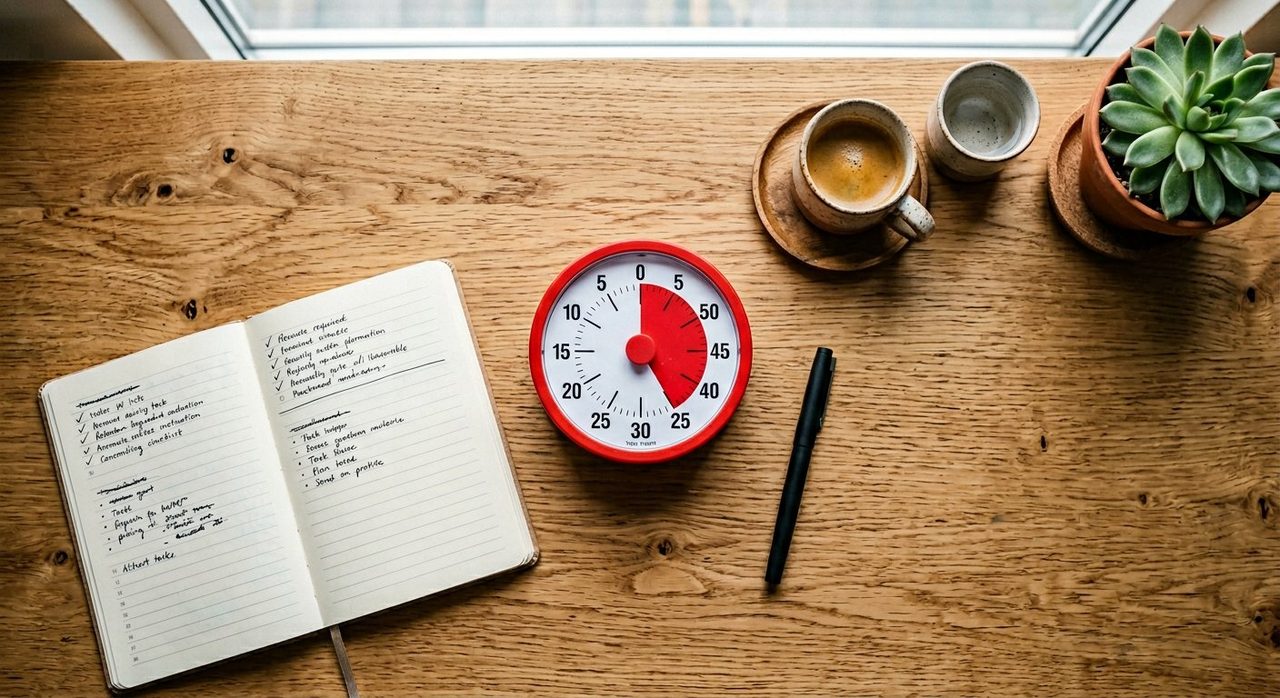
Not exercise — just movement. Stand up, stretch, refill water, walk to a window. The Pomodoro Technique works partly because of this enforced movement. See our Pomodoro guide.
4. Stop multitasking video calls
Doing email during a meeting feels productive; it doubles the cognitive load. Either be in the meeting or excuse yourself. Single-tasking is restful by comparison.
5. Schedule a "closing ritual"
At a fixed end-of-day time, do the same 3-5 actions: review tomorrow's task, close all tabs, push in chair, switch off lamp, walk away. The repetition trains your brain to truly stop.
6. Eat lunch away from your desk
Even a 20-minute lunch in another room dramatically restores afternoon energy. Lunch at your desk extends the work-mode by the duration of lunch. See our lunch break guide.
7. Cut caffeine after 2pm
Caffeine has a 5-6 hour half-life. A 3pm coffee is still affecting your sleep at midnight, even if you fall asleep fine. Bad sleep = more tired the next day = the cycle continues.
Supportive products (none required)
Sunrise Alarm Clock (Hatch Restore 2)
Simulates sunrise if you can't get outdoor morning sun in winter. Genuinely helps with circadian rhythm.
Check price on AmazonStanding Desk (FlexiSpot E7)
The biggest single change to "sitting still all day" — see our standing desk guide.
Check price on AmazonApple Watch / Fitbit
The "stand reminder" feature is mocked but works — the gentle nudge to move actually moves people, and consistent movement reduces fatigue.
Check price on AmazonWhat about diet and sleep?
Yes, both matter — but most remote workers chronically tired by 5pm have decent sleep and diet. The unique-to-WFH causes are the ones above. Fix those first; revisit diet/sleep only if fatigue persists.
Final word
Remote work doesn't have to be more draining than office work. It usually is because of the missing transitions, sustained low-grade vigilance, and lack of movement that the office structure handled for you for free. Reconstruct those intentionally — sunlight, fake commute, movement breaks, closing ritual — and you'll get the "more energy after work" benefit that remote work was supposed to deliver.
Frequently asked questions
Why am I so tired after working from home if I'm not commuting?
Three main reasons: lack of natural transitions between work and home, prolonged sitting in one position, and the cognitive load of self-directing your day without office structure. All three are fixable.
Is 'Zoom fatigue' a real thing?
Yes, with measurable causes — Stanford research identifies four mechanisms including excessive close-up eye contact and constant self-monitoring. We have a dedicated guide on preventing it.
How long should I exercise to feel less tired after work?
Counter-intuitively, even 10 minutes of light exercise during the workday reduces end-of-day fatigue more than longer exercise at the day's end. Movement during work prevents fatigue rather than recovering from it.
Does my morning routine affect how tired I feel by 5pm?
Hugely. Skipping a real morning routine (especially missing sunlight exposure) sets you up for an energy crash by mid-afternoon. See our morning routine guide.
Will caffeine help with afternoon fatigue?
Short-term yes, long-term no. Caffeine past 2pm disrupts sleep, which makes you more tired the next day. The 2pm rule: no caffeine after 2pm if you're already feeling chronic fatigue.
Spotted a mistake or want to suggest a product we should test? Get in touch — we read every message.